I
I arrived at Paddington and was hastily directed to the farthest end of the platform, for those without sleeping berths, finding the carriage sparsely populated but with two parallel rows of strip lights running the length of its ceiling – these were not to be dimmed for the duration of the journey. I had intended to set about reading Defoe's third letter in A Tour Through the Whole Island of Great Britain (London to Land's End), but reached only Exeter before conceding defeat and trying to get some rest. My progress had outstripped the train, however, which was by now at Reading. After a few hours of fragmentary sleep spread awkwardly across the double seat, I returned somewhat listlessly to Defoe to pass the time before heading to the bar carriage; the sole employee also complained at spending the entire jounrey under the harsh onboard lighting. Sunrise began as the train passed over the viaduct into Truro. I disembarked and headed to the Cathedral at which we were to meet.
I noted a family business near the station advertising themselves as Builders and Funeral Directors, before passing the Wilkinson's in the death throes of its administration sale, the staff beginning to deposit what little, and disparate, stock remained upon the emptying shelves. I stood for a while at High Cross looking up at the Gothic Revival frontage – a not wholly happy marriage of Cornish granite with the Bath stone used for ornamentation – turning then to the former Assembly Rooms, now the façade to an estate agent. The Cornish Enlightenment, that building, Christie remarked half-jokingly after his arrival, having endured a night of even less sleep than myself; a month-long saga of inadequate treatment for a skin condition had left him unable to lay still for extended periods, although he was in relatively good spirits. We walked off in search of food. He was undertaking doctoral research around Newlyn, taking in also Mousehole and Paul, but was spending the weekend back home in Truro. I'd been here once a decade ago, but only for a few hours on my way further west. I asked the origin of the name: likely from three rivers, the third of which scarcely can be said to exist anymore. Breakfast was fine, served on a plate which presumably began life in a Chinese restaurant given the faded calligraphy printed around its rim. We moved towards home, seeing the former mayor, also a local historian. Controversial, I think, but for a reason I can no longer recall. We reached the stone steps up to the lane on which Christie had grown up, just as his mum was heading out. She'd lived here for over forty years, working at the local Jobcentre. Bags deposited; we headed out.
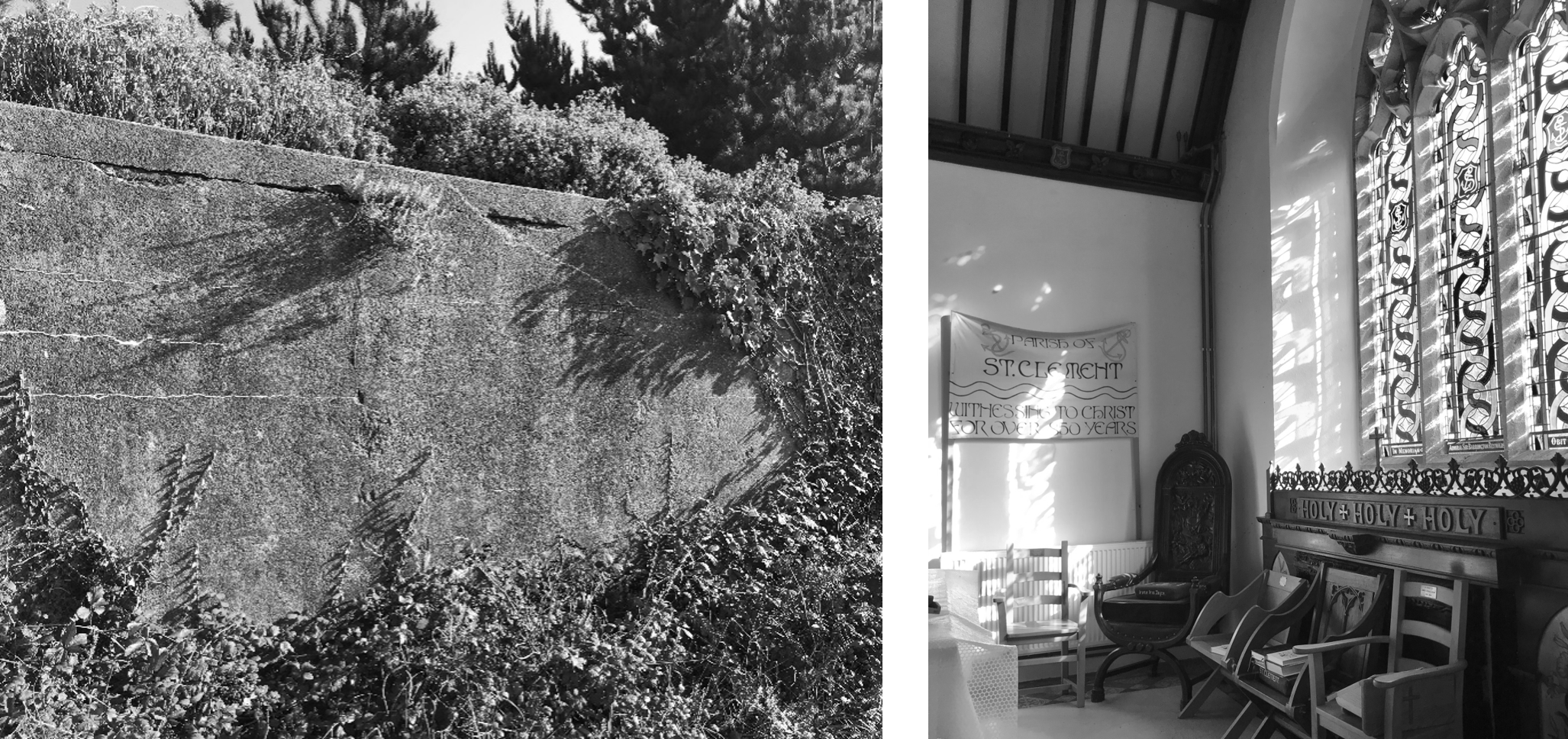
A track runs uphill, past the private school, and up through a woodland, before opening to a field, at the edge of which stands what Christie had long believed was a pillbox. In fact, a quite needlessly robust concrete water tank built by German prisoners of war, who later chose to settle in the area. He pointed out the extent of the land owned by The Viscount Falmouth, recalling once setting out with a friend in a dilapidated canoe, ultimately reaching a cove near Falmouth's estate. They found, and claimed for themselves, some outdoor furniture, among other items. At which point, the Viscount descended from the woodland and stood for a while silently inspecting the boys – and their haul. He muttered something in leaving: don't make a habit of it.
We arrived at St Clement's Church, a twelth century site with most additions made in the fifteenth. A group of travelling bellringers – The All Sorts – were unlocking the tower, and having this year taken up bellringing himself, Christie was invited to join with rounds and chord-changes. I remained in the nave talking with members of The All Sorts, including an anthropologist who had been teaching English in Iran during the Revolution. She mentioned having then moved to Saudi Arabia, at which point another bellringer descended from the tower and began discussing T.E. Lawrence.
Returned to Truro, we caught the bus to St Agnes. Swimming out of Trevellas Cove, my inferior ability became immediately apparent, and having caught my knee against a submerged rock, I was forced to clamber inelegantly onto some barnacle-encrusted granite about a hundred metres from the beach. The idea of my jumping from the ledges, our original destination, was always improbable. Abandoned tin mines run down the narrow valley to Trevallas, marked out by their now-ruinous Cornish engine houses, in the shadow of which we lay for a while and fell half-asleep, before walking back into the village. Christie recognised the mother of a school-friend was also waiting at the bus stop, and we struck up conversation during the return journey; he couldn't quite remember her name.
I was to be shown the Truro nightlife, beginning in the former British Legion – now a nightclub, the new proprietors appeared to have gotten only half-way through the redecoration. In leaving, we passed someone Christie knew from school: a boxer selling disposable vapes. He was going to turn pro, soon.
The White Hart – home of The Truro Old Boys – followed, with the haze from a low-power fog machine and a lurid laser display framed by the single-glazed windows. A girl asked for papers and a filter, but we were no help. I'd left all tobacco at home before leaving, in the hope the trip was to be a juncture through which to quit, having resumed the habit in April. Stepping outside, we saw she'd acquired the apparatus elsewhere, so Christie scaffed a cigarette.
Sunday began with a swim at Loe Beach. Far easier going than the day before, I joked of having taken the waters as we ate homemade saffron buns on the shore. Christie had slept very poorly and was somewhat dreading singing that afternoon in a service commemorating local men who had taken their own lives – the highest suicide-rate in the country. We decided it best I not attend. I would head to Redruth instead, with a tour of the Cathedral at midday before leaving. Against my better judgement, I went into a record shop as we passed through the city centre – the sorting was typical of such stores, with the limited music of interest relegated to an amorphous assemblage in a milk crate towards the shop's rear. I pulled out an inscrutable dance record from '93; the centre label artwork suggested it might be good. There was no listening deck. I gave up and left.
The Cathedral stands on the original site of St Mary's Church, demolished in the 1880's, excepting the south aisle now incorporated into the Cathedral. John Loughborough Pearson built a smaller replica of the Cathedral in Melbourne: another Cornish pommie. There is an impressive terracotta rendering of the Via Dolorosa by George Tinworth along the wall of the North Aisle – one of the Roman soldiers here was meant to resemble the Prince Regent. Down the South Aisle, a woman was selling coasters and placemats: slates recently removed from St Mary's. The previous Dean left his wife for her, Christie told me as we walked away, slates-in-hand. Third time it'd happened with a lay preacher.
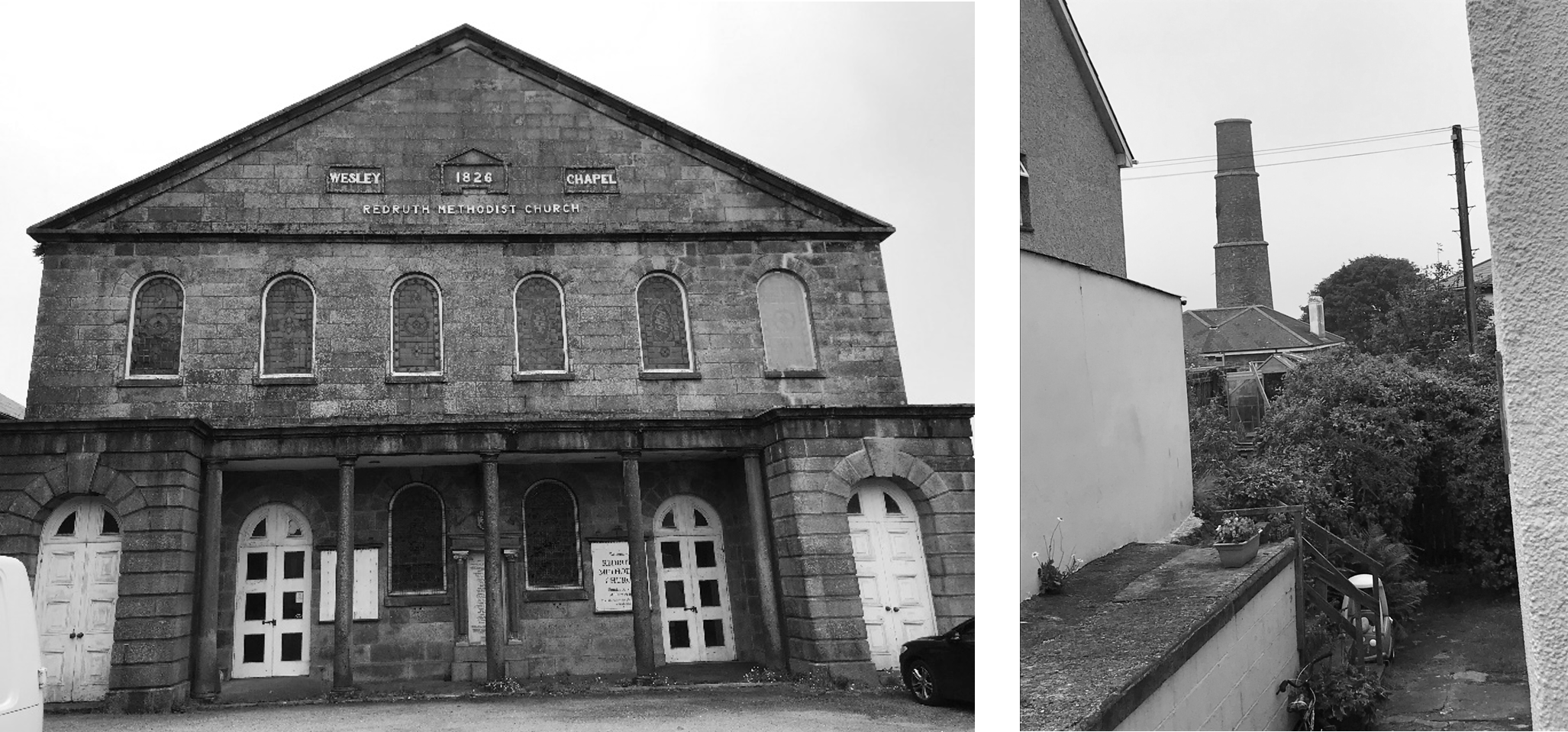
I headed back up the hill towards the station to catch the train to Redruth, finding replacement buses were in operation and a crowd outside growing agitated. I caught the T1 instead. Arriving an hour later than planned, I passed via the ruins of St Rumon's Chapel before heading to climb Carn Marth. Once extensively quarried for granite, the excavations now lie filled with water at its top, from which Falmouth Bay was just visible to the east despite the haze. Returning into town to visit the Methodist Church – a proud, plain rectangle by Pevsner's reckoning, now quite degraded – I was intrigued by a chimney-like structure nearby, seemingly in a back-garden given the lack of public access. I tried peering through the windows in the Church doors; the lights were out. Passing the clock tower, I called in quickly at the Red Lion, by now playing hard-house edits of Brit-pop. The history of wealth in the town is obvious, particularly from the vantage point afforded by the viaduct passing through the town. Things had improved since my last visit.
I gratefully received dinner again at home that evening. The service at the Cathedral had been well-attended, mostly by widows and parents. I mentioned also seeing the moribund Wilkinson's in Redruth. A good local employer, I was told, especially for disability adjustments, before conversation worked its way towards the final mine closure at South Crofty in 1998, at which Christie mentioned what was written on the gates soon afterwards:
Cornish lads are fishermen
and Cornish lads are miners too.
But when the fish and tin are gone,
what are the Cornish boys to do?
II
I was hungry by the time the bus dropped us up Chywoone Hill – the distance was short from Penzance station to Newlyn, but Christie had luggage. For the past months, he'd been renting a room in a semi-detached house about a third the way up the hill. The house was a work in progress, and the stairs had been stripped, but the outline of a comfortable home was already clear. I had the spare room. We went downhill for lunch, and eating at the harbour, Christie gestured behind us. They make equipment for playgrounds now – pays better than fishing nets; he has to send his pilchards to France to be tinned in the way he likes: cooked first, then canned – they're good. The Tidal Gauge and Observatory – the vertical datum for Great Britain and pivotal within GPS calibration – was off to our right, within an unassuming red and white hut smattered with brown corrosion smears. To our left, the newbuild RNLI centre was open. If it is a girl, she will be a telephonist, for the R-N-L-I. An exhibition on the Solomon Browne dominates, sunk attempting a rescue of the Union Star in 1981 – they all died. If it is a boy, he will work on a lifeboat saving people stranded, at Sea. He will not be afraid of harsh weather conditions, which could make his job: more hazardous. The boards are scant on detail. A third boat sank that night, Christie commented as I read. Nobody talks about it.
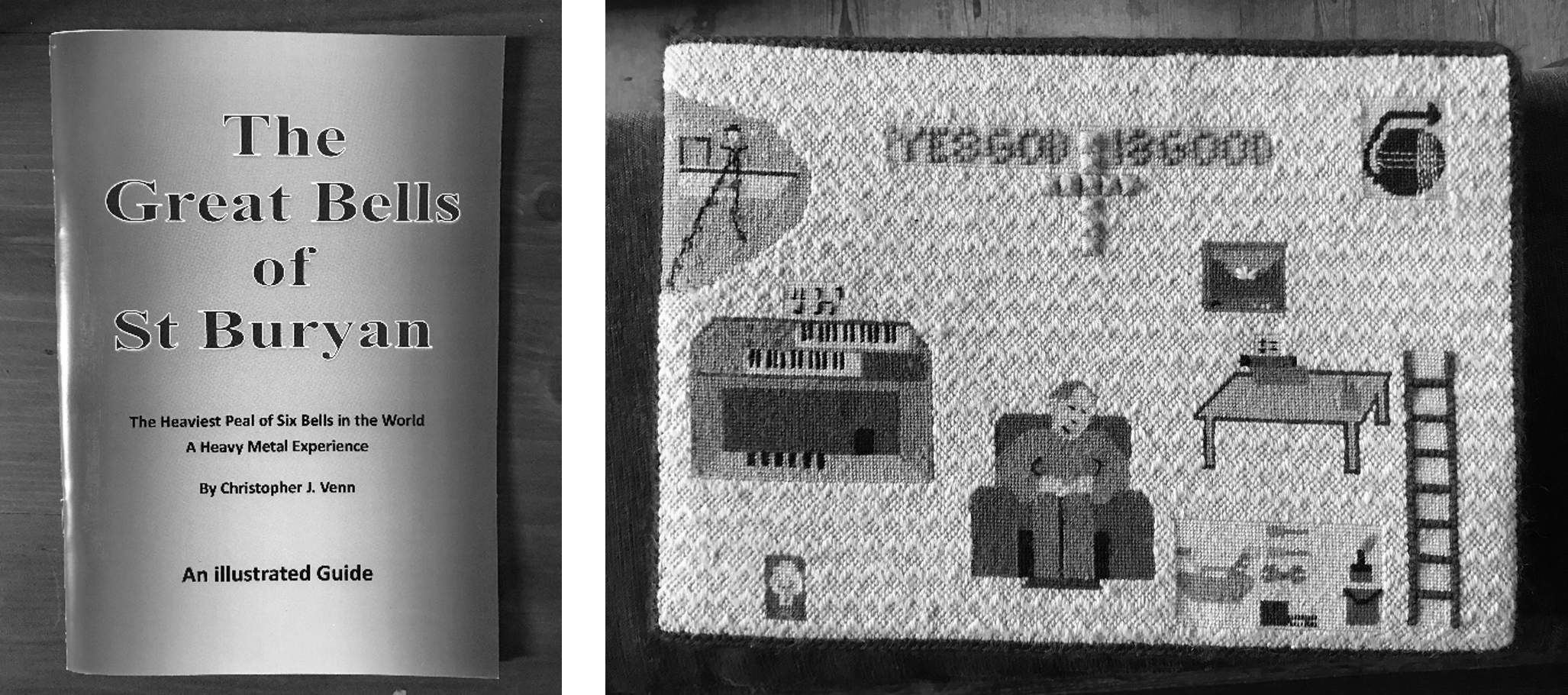
We caught the bus to the Merry Maidens, passing The Pipers. It didn't use to look like this. The Victorians moved and replaced some of the stones. We walked onwards to St Buryan, filming location of Straw Dogs. The Eglos of St Beriana, some call it St Buryan Cathedral, has a circular churchyard and very heavy bells. And the handmade prayer cushions are a source of amusement. A Norman tombstone is mounted on the wall behind the children's play area. The rood screen is well-preserved – a pamphlet drew attention to the potted plants engraved at its base.
The bus stop was at the Celtic cross outside. I'd gone about saving for now Defoe's final section of the letter, covering our current environ. Here are also a great many good families of gentlemen, though in this utmost angle of the nation; and, which is yet more strange, the veins of lead, tin, and copper ore, are said to be seen, even to the utmost extent of land and at low water mark, and in the very sea; so rich, so valuable a treasure is contained in these parts of Great Britian, though they are supposed to be so poor, because so very remote from London, which is the centre of our wealth.
We climbed down from the open top deck, got off outside Paul, and walked to St Pol de Léon. The original church was largely destroyed by Spanish forces in the 16th century. In more recent times, the church has housed a measurement centre for absolute gravity, just to the right of the Hammond organ. The methodology – published by Williams et al. (2001) in Geophysical Research Letters 28(12), building on the work of Niebauer et al. (1995) in Metrologia 32(159) – relies on directing an iodine-stabilised laser at a corner cube retroflector (to minimise scattering) which is free-falling in vacuo; an interferometer forms two coherent laser beams and through interference fringes is able to compare the distance travelled by the beam directed at the retroflector against the second beam which travels a known internal lengthscale, thereby allowing determination of the free-fall distance of the retroflector and hence its acceleration under gravity. The apparatus is accurate to two billionths of the true value of the gravitational field strength on earth. St Pol de Léon was chosen owing to its proximity to the Newlyn Tidal Gauge with its aforementioned role in GPS – the other method through which gravity could be determined empirically for comparison against the absolute gravitometer. Christie was meant to be at choir practice here in a couple of hours but had cancelled on account of his maladies. He played the organ while I roamed and browsed the books on sale at the rear. The King's Arms is opposite. These might have to be quick; the choir normally starts turning up soon. Yeah – they're here – let's go. We saw off the two Tributes and set off down the winding hill, into Mousehole. The rolling English drunkard made the rolling English road.
We ducked into to the Trewavas club. There was a Victoria Cross at the back-right corner. Christie put some fifty pence pieces on the side of the snooker table. The current holder of the cue – his appearance did not balk at falling into cliché – took no notice. After twenty or so minutes, the table was laconically handed over to us. We played a couple of games before leaving. Christie had wanted to play against the prior incumbent – he'd seen him in here before. I was taken for a tour of Mousehole, starting with the Solomon Browne memorial hall. Most of the crew were from here. There had always been disquiet regarding those who had emerged when compensation for the disaster was being distributed, and this hall had been no less controversial. It was not really fit for purpose, but still managed to syphon events, and funding, away from the old Methodist Hall, our next stop. The stained-glass windows were bowing under the weight of lead, and Christie pointed out how far they'd gotten with the fundraiser.

Our prior acquaintance was at the bus stop in the harbour, having taken his pint down with him. And he was in a cantankerous mood, chuntering about tourists bringing disease – Christie had pointed out the proliferation of holiday homes – and how he the ought to start shooting them. The haggard man gave a spluttering cough, and the diminutive bus arrived. Back in Newlyn, Christie went off to drop his bag at the house and record some notes while I waited for our order at Lewis', which we ate in the Swordfish pub garden. It was once voted the second roughest pub in Britain. Now, a polka dot jersey – King of the Mountains – discussed disc brakes behind us. We went to the Coop to get cash out, for The Star Inn was next: £20 card minimum. A boy, around sixteen, came furtively into the shop. He was bleeding from his arm, partially bandaged. I couldn't decipher what he said before leaving hurriedly.
The pub was laden with history, an unofficial archive. This was Denise's nook; that plaque is a memorial to the Solomon Browne; there's the Golliwog behind the bar. I had been told about here. Christie pointed out the England flag draped behind the bar – the first I'd seen during my visit. Mickey was at the bar, and Christie went up to chat. I hung back, in Denise's nook. A stool was pulled up for me. I'd made the mistake of wearing a cap. He wants to look important, Mickey reckoned. Christie gestured towards the jukebox and mentioned my liking – he called it an obsession – for techno. Well, you can keep that. I was on shaky ground here. Christie turned to a punter at the bar he hadn't met previously, so I struck up conversation with Mickey. We found some common ground bemoaning the relinquishment of British industry to asset strippers and spivs. He'd been a welder at a shipyard, spent twenty years in Brighton on smack. Dad fought in the war, then he'd worked on Nuclear. At Sellafield? No, mostly South Africa. I took pause, then mentioned a conversation I'd had two days prior with an autodidact member of The All Sorts about the original Windscale reactors. The design was flawed, we had agreed, but Britain wanted The Bomb, with a bloody Union Jack on top of it. The Windscale reactors were moderated with graphite and cooled with air – Hendon was sceptical of the water-cooling used by the Americans, who were increasingly disobliging with information exchange. A quarter tonne of air was needed every second. Pile 1 caught fire in 1957 during one of the periodic heat releases, not before the reactor had spread uranium oxide powder across Cumbria for the preceding years. The filters couldn't handle the flowrate. One zap had done for Dad, Mickey reckoned. He was probably right.
III
The morning had been slow. We'd intended to visit Men Scryfa and Mên-an-Tol, but it was close to three now, and my original plans of leaving that evening were already abandoned. The distance was short, but the buses inefficient. A tortuous call to a car rental proved fruitless: £155 for one day, earliest collection from five; they closed at four. The bus left Penzance at three-thirty and struggled along the single-lane roads as the landscape gave way to moorland. A schoolboy, about twelve, got off and wandered into the moor. For a quick slash, I imagined, although the bus drove off regardless – a Young Druid, potentially.
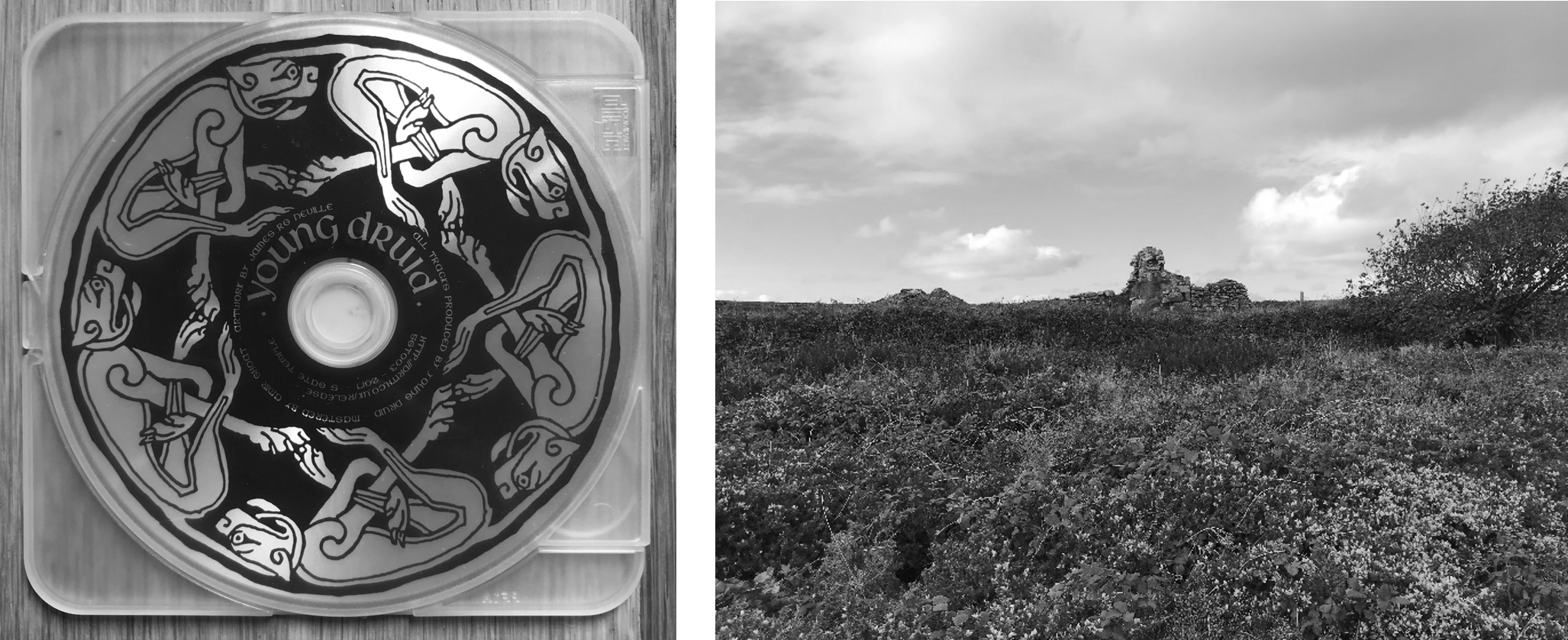
Christie was asleep, and disoriented when I jolted him awake, thinking us near. Get off here, he reckoned. That might have been a mistake – the bus was gone now. The plan, loosely, was to curve round the hill and reach Boskednan, from whence we would perform a circuit of the other nearby stones and climb Carn Galver. I wondered how much light we might still have. Reliant upon his intuition, we headed into the moorland, eventually reaching an actual path. Police are aware motorists have been using these tracks illegally. Presumably, to reach nearby points of interest – we can't be so far off. Turning left off the track up another path, Boskednan appeared on the horizon. I was impressed. The field containing Men Scryfa was visible in the distance. We'd pass three streams to reach there, then Mên-an-Tol, which Christie speculated was all erected as the playing field for a now-inscrutable game.
Rialobrani Cunovali fili. Someone had tried setting fire to the stone since I last visited, evidenced by singed lichen on its face. We sat for a while. The stone likely long predates the inscription of remembrance. A frayed length of carmine rope was tied at the gate to the field – Old and Red.
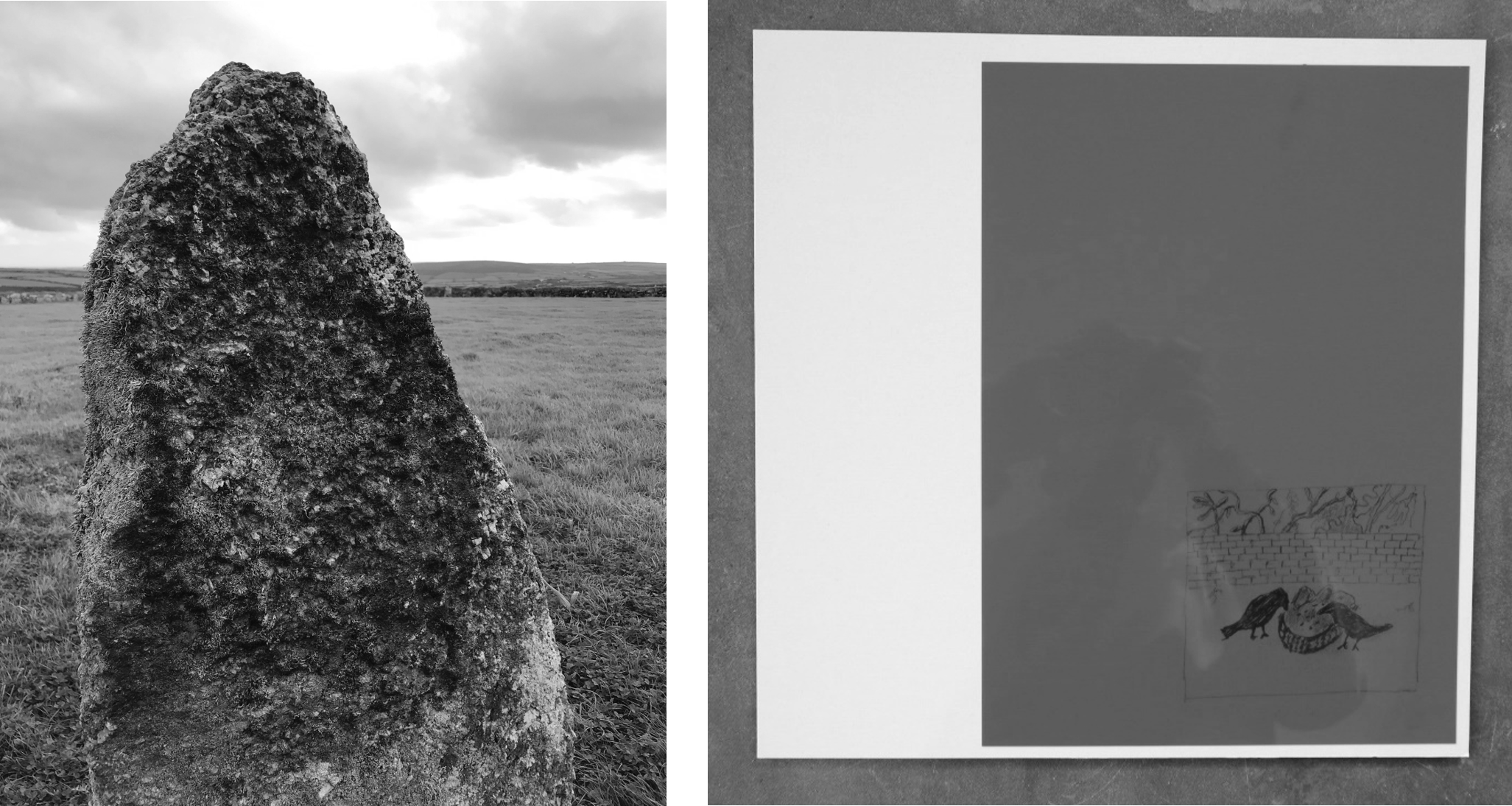
The sun broke through the clouds as we reached the top of Carn Galver. The Atlantic extended to our left, with Bosporthennis and Zennor ahead. The amber paint of the Gurnard's Head was visible about two kilometres away. We followed the road, surely one of the best in Britain, to the pub. There were no tables, and the final bus had already passed us. Drinks and snacks were possible, though. The walk had been perfect. I went to pay – they'd forgotten to charge for food. We would try to hitchhike back to Penzance. No. No. Yes. It was a dairy farmer, and his wife feeding him crisps. We're only going as far as Boswarthan, but it'll save you some miles. That's grand. We got to talking. Things were tough, but okay – prices are always faster up than down. They'd been out for a drive having looked at paint for a recently purchased vintage tractor: Ferguson-Brown. The exact model remained a mystery. It's easy to tell, a friend had said: just compare the left and right doors. It didn't have any doors. Some of their land had been designated as an SSSI. Yes, I'd read about this in Penwith. They knew of one entire farm being made an SSSI. Finished, and with no compensation. We pulled into a layby – he'd taken us all the way to Penzance.
Christie was to attend the archive in the morning. We were half-hour late, but in time to grab food from the Butchers before they had sold out. Nigel had opened up; Christie passed him a pasty, turning down the offer of money. We started on the boxes on families and individuals. The Reverand Wladislaw Lach-Szyrma was to be an important figure in the thesis. A professor of Philosophy, he fled Poland circa 1830 during the Cadet Revolution, ending up in Newlyn for the 1870's and 80's. Deeply religious, but profoundly invested in contemporary science – he'd founded the Penzance Natural History and Antiquarian society – Lach-Szyrma ended up writing early science-fiction. In Aleriel, or A Voyage to Other Worlds, he is believed to be the first author to use the word Martian. The Reverand also lead the construction of the harbour wall. Although C of E, the Methodists took off their hats for him. He was once accidentally declared dead while away in Paris.
The artefacts drawer was opened. A copper plate, made by a fisherman as something to do onshore – a poor example. A shoddily made medal to commemorate the coronation of George VI. A pocket diary for 1945 with terse and specific entries. April 25: three years since green bathing suit. April 27: five years since burglary. Christie handed me tapes from the video archive drawer: A.L. Rowse at 78; The Life and Times of Dylan Thomas in Mousehole; Dora Russell, talking about D.H. Lawrence. (Bertrand's wife, he added.) Dora talks about how her husband and Lawrence did not get on. Points of Interest: there is only 2 mins of what is obviously a much longer interview, hopefully I will come across the thing in due course. I mentioned the account Lawrence gives in Kangaroo of his – no, sorry, Richard Lovat Somers' – time in Zennor during the First World War, being continually asked to report, then rejected as not medically fit. If he was called up again, he would go again. But he would never serve. It was the vast mob-spirit, which he could never acquiesce in. He hated the war and said so to the few Cornish people around. He laughed at the palpable lies of the press, bitterly. And because of his isolation and his absolute separateness, he was marked out as a spy. The experience precipitated his savage pilgrimmage, I added. Christie said he should buy a copy, so he could read a third of it. This had been a recurrent theme. The least scholarly person I know, a mutual friend had once said in frustrated jest. Certainly untrue, although I was amused by his rather rough manner with the archive boxes.
The archive contains two model ships. The Rosebud was sailed to Parliament in 1937 to protest against the Newlyn Clearances. A public inquiry was told 303 houses in Newlyn were not fit for habitation and needed demolishing to start anew. The replacement social housing was unaffordable for the current inhabitants. Alec Beechman MP received the Rosebud at parliament with tea, scones, and pasties. The demolition went ahead. The replacement housing mostly went to Belgian refugees during the war. Christie had tried looking into this, but the story remained unclear. Some say the Belgians mucked in well. Others say they kept to themselves. The Rosebud was ultimately left rotting in the Hayle estuary; people took chunks. There's one atop the bookcase in the archive. In 2000, Penwith Housing Association built a new social housing scheme. They called it Rosebud Court. The model of the Mystery is to one's right upon entering the archive. In 1854, seven Cornishmen, all shareholders in the lugger, wanted to leave and find gold in Australia. Selling the Mystery would not cover their costs, so they figured they had might as well sail it there instead. They went through two hurricanes. I wondered aloud at the nominative determinism of such a name: Mystery. Christie was by now consumed again with fatigue and soon fell asleep at a table in the back of the archives. Before looking at the ships, the boxes on Thomas Cooper Gotch had been laid out for me. Tangentially connected with the Pre-Raphaelite movement, he'd trained in London, Paris, then Antwerp. After time spent in Australia, he settled in Newlyn. His daughter had led the publicity campaign for the Rosebud. I flicked through the boxes, starting with his scenes. Mental Arithmetic and Sharing Fish had received poor public receptions, hastening his departure from naturalism – a shame. The former is now in private hands, the latter at the National Gallery of Victoria. I opened another box and saw a portrait.
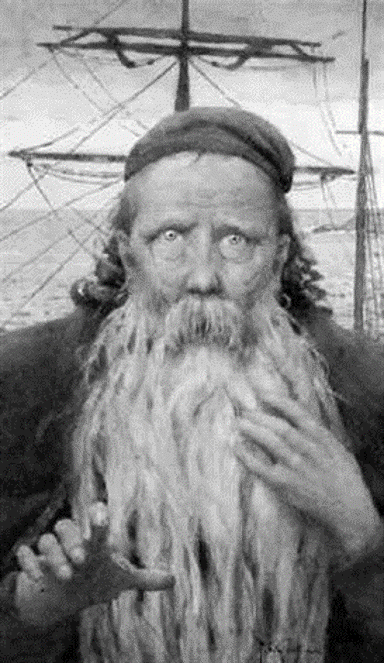
I stared for a while: It is an Ancient Mariner. A watercolour, surprisingly. There was an excellent photograph in the archive. I guessed at some Coleridgian influence and wondered if the painting is on public display somewhere – very little online, seems to have been sold at private auction. Christie was awake now, and Nigel asked if it had been a heavy night. Christie explained his situation. The archive shuts in twenty minutes – you might as well go – I can man the fort. We shook hands. He'd left a message for Christie in the leaving card: follow the light. Nigel's a Quaker. Christie needed to return a book on T.C. Gotch to Pamela Lomax: its author. She may know of the Mariner's whereabouts. I flicked through The Golden Dream: a biography of Thomas Cooper Gotch and found it: a small photo of the painting in the chapter on Gotch's final years. We climbed the hill to the Gotch house. Pamela lived there now, as had Aleister Crowley in the intervening years. I'd read in the archive that the painting was of a Jew in Mousehole, indicated by the hat they reckoned. Christie remembered reading it was a self-portrait made in old age. We both preferred the latter explanation with less of an antisemitic undertone, although the resemblance to Gotch was poor. Pamela was out. Our luck was running out. And I ought to leave soon. I picked up my bags and we walked into Penzance to make one last stop.
The Morrab library was founded in 1818 and moved to its current premises in 1889. The house and gardens were built in 1841 for the brewer Samuel Pidwell. The Pidwells moved to Portugal, and the Council ultimately acquired the property, thinking it important to have public gardens next to the promenade along the waters. The library pays no rent to the Council but cover all maintenance. Christie bumped into an elderly lady leaving the Cornish History room. He thanked her for lending those leaflets; she couldn't remember which ones. Nigel was recently widowed, I overheard. He was doing well, yes, very well. And he'd taken in that family from Ukraine. That boy really should be back there fighting, though. Christie and I said we'd have done similar. Well, you don't deserve your educations, she replied, matter of fact, before continuing pleasantly enough. I'd read that morning of America sending depleted uranium munitions to Ukraine, following the UK's lead. Most of the British stockpile is stored near Windscale. Christie had pulled out and handed to me copy of Memories of Men and Women by A.L. Rowse – even he'd grown very fond of the Morrab and left a large donation of books. I skimmed the chapter on Beaverbrook while the conversation wound down, after which we ducked outside to speak with the librarian.
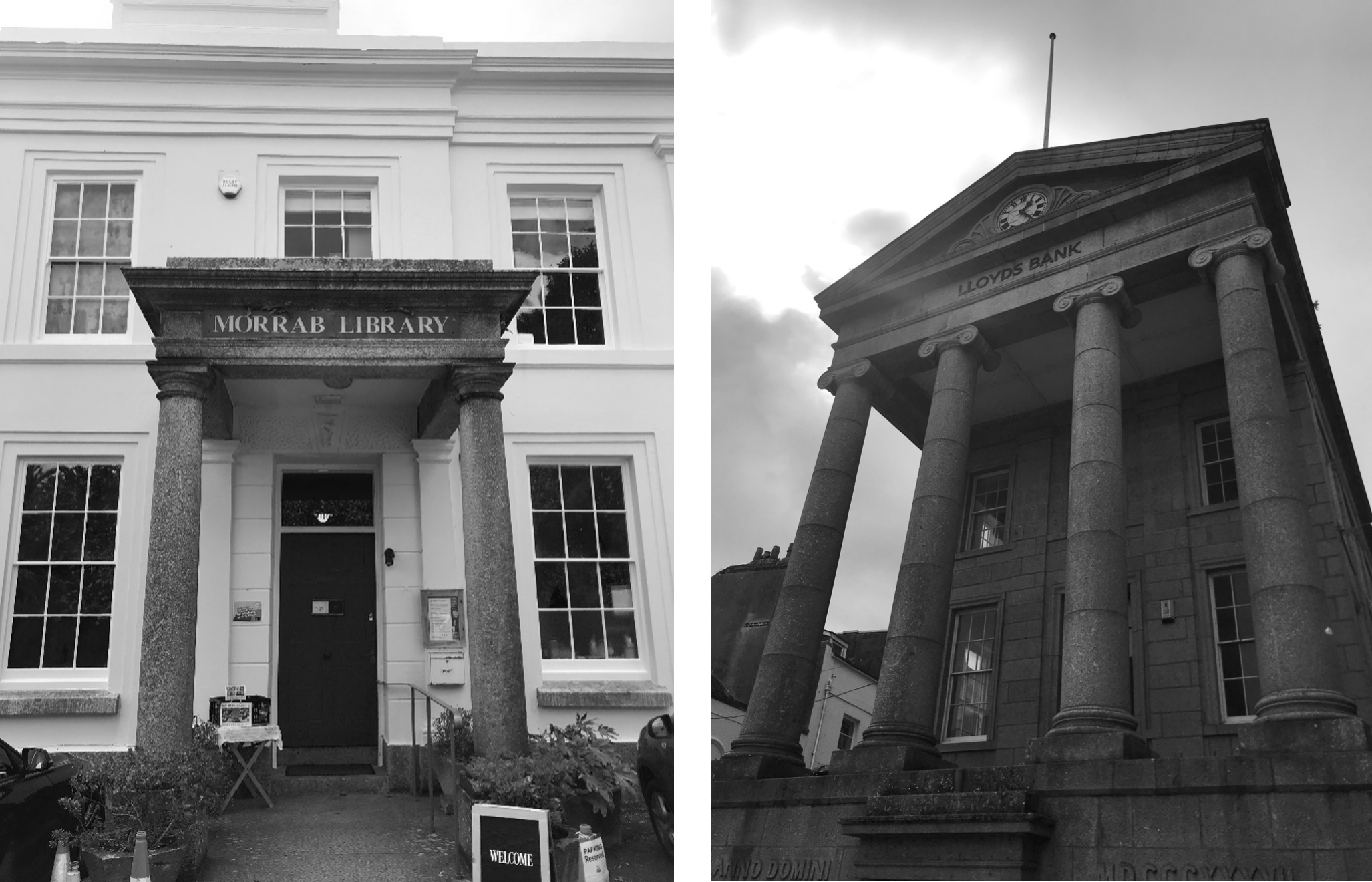
We continued towards the station. That building was where Lach-Szyrma hosted the Antiquarian society. It's a bank now – they wouldn't let Christie in. There was a statue of Humphry Davy outside. We discussed his cavalier experiments with nitrous oxide, and I recalled reading a paper – I think it was by him – on the frigidative effects of ammonium salts in water. The manuscript concluded that coldness was being liberated from the salts, and proposed usage for the chilling of wine in summer months. We considered the mutability of scientific knowledge, not that you'd know of it now. Lach-Szyrma had written a lot on aether, Christie mentioned, having a few months ago on this street met a man who was distributing leaflets on the high street – they claimed Penzance to be a Universal centre of untapped aethereal energy. I hugged Christie as we parted at the station, and I asked if he could please take a high-quality scan of the Gotch photograph next time, the final time, he was to be in the archive.
IV
We are being held at a red signal. There was unfortunately a fatality on the line today at Plymouth. The Police have declared the event non-suspicious. Owing to the subsequent backlog of rail traffic ahead of us, progress from Liskeard was slow and incremental. I had to join a video call in a few hours, the onboard internet didn't work, and I had long since ran out of mobile data. The train wouldn't reach Paddington in time. I took this as an excuse to get off in Plymouth, and walked off to find an internet connection. Armada Way, leading down from the station, was in the midst of heavy redevelopment. The tower of the Guild Hall also hinted at Spain: Mudéjar meets Gothic Revival.
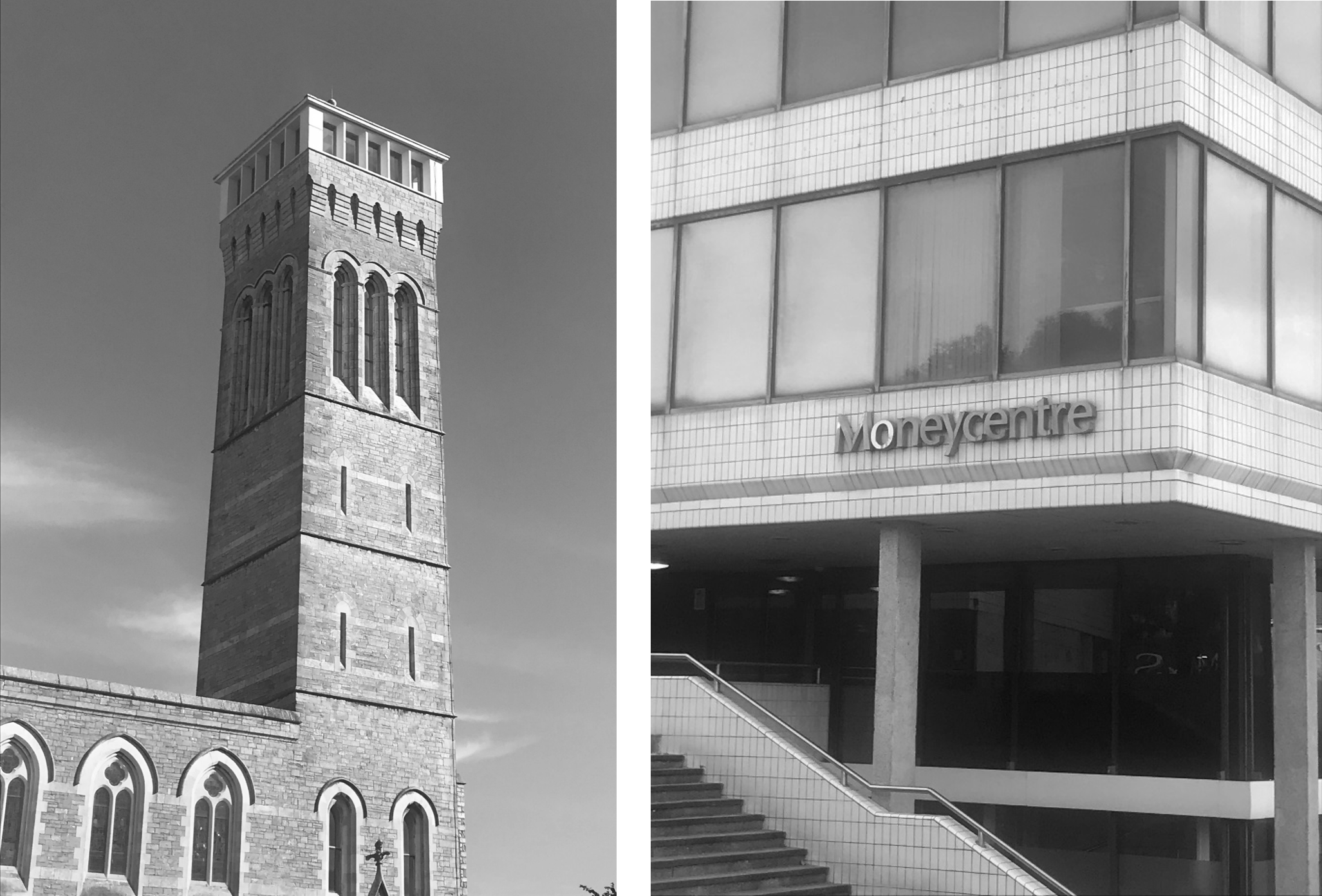
The Portland stone buildings of the city centre have aged very well – they're certainly not the problem. My search for internet connection in the early evening had led to a wine bar down a side-street beyond St Andrew's Church. The maroon-chinoed proprietor, already clearly bardered, was perplexed by my inquiry. He looked familiar. A staff member behind the bar passed me the passcode on an order slip and kindly advised signal was strongest in the back corner. I sat down and pulled out my laptop while the owner haphazardly went about calling a taxi for an elderly patron who had taken a turn. The internet connection was, predictably, atrocious. I departed, and ultimately found success in a quiet corner of the Drake Circus. The bar owner had looked like Tom Burke. The Picpoul had cost £8.
I boarded the train again at Plymouth and returned to Defoe, aiming now at completing Letter Four (Land's End to London, this time via the North Coast). My mistake in having failed to buy dinner in Plymouth soon became apparent, and I was left spending close to a tenner on crisps, tea and a chocolate bar from the trolley, which had sold out of all sandwiches besides an anaemic BLT. I was home five hours later, and noticed on my phone a browser tab had now loaded from my failed attempt to listen to the record I'd seen in Truro. I began listening to the rip of the record. And I thanked myself for having left it behind.